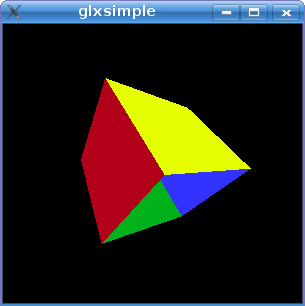
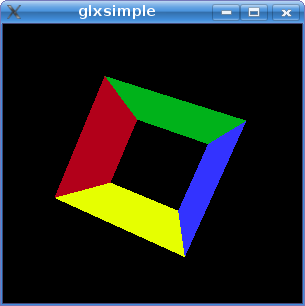
Il faut bien démarrer quelque part et c'est ici ! C'est sûr que c'est pas terrible, beaucoup de code pour un résultat bien consternant, mais je jette mes bases. Je dois reprendre ce qui était naturel il y a quelques années...
#include <stdio.h>
#include <stdlib.h>
#include <X11/Xlib.h>
#include <GL/glx.h>
#include <GL/gl.h>

static  int snglBuf[] = {GLX_RGBA, GLX_RED_SIZE, 1, GLX_GREEN_SIZE, 1, GLX_BLUE_SIZE, 1, GLX_DEPTH_SIZE, 12, None};
static  int dblBuf[] =  {GLX_RGBA, GLX_RED_SIZE, 1, GLX_GREEN_SIZE, 1, GLX_BLUE_SIZE, 1, GLX_DEPTH_SIZE, 12, GLX_DOUBLEBUFFER, None};

Display*    Dpy;
Window  Win;
Bool    DoubleBuffer = True;

GLfloat XAngle = 42.0, YAngle = 82.0, ZAngle = 112.0;

int FatalError(int errorCode, char* str)
{
    printf("%s\n", str);
    return errorCode;
}

void    redraw()
{
static  Bool    DisplayListInited = False;
    if (DisplayListInited)      {
        glCallList(1);
    }   else    {
        glNewList(1, GL_COMPILE_AND_EXECUTE);
        //
        glClear(GL_COLOR_BUFFER_BIT | GL_DEPTH_BUFFER_BIT);
        glBegin(GL_QUADS);
        glColor3f(0.0, 0.7, 0.1);       //Green
        glVertex3f(-1.0, 1.0, 1.0);
        glVertex3f(1.0, 1.0, 1.0);
        glVertex3f(1.0, -1.0, 1.0);
        glVertex3f(-1.0, -1.0, 1.0);
        glColor3f(0.9, 1.0, 0.0);       //Yellow
        glVertex3f(-1.0, 1.0, -1.0);
        glVertex3f(1.0, 1.0, -1.0);
        glVertex3f(1.0, -1.0, -1.0);
        glVertex3f(-1.0, -1.0, -1.0);
        glColor3f(0.2, 0.2, 1.0);       //Blue
        glVertex3f(-1.0, 1.0, 1.0);
        glVertex3f(1.0, 1.0, 1.0);
        glVertex3f(1.0, 1.0, -1.0);
        glVertex3f(-1.0, 1.0, -1.0);
        glColor3f(0.7, 0.0, 0.1);       //Red
        glVertex3f(-1.0, -1.0, 1.0);
        glVertex3f(1.0, -1.0, 1.0);
        glVertex3f(1.0, -1.0, -1.0);
        glVertex3f(-1.0, -1.0, -1.0);
        glEnd();
        //
        glEndList();
        DisplayListInited = True;
    }
    //On affiche réellement quelque chose...
    if (DoubleBuffer)       glXSwapBuffers(Dpy, Win);
    else                    glFlush();
}

int main(int argc, char** argv)
{
    XVisualInfo*    vi;
    Colormap    CMap;
    XSetWindowAttributes    swa;
    GLXContext  cx;
    XEvent  Event;
    Bool    NeedRedraw = False, RecalcModelView = True;
    int Dummy;
    //
    Dpy = XOpenDisplay(NULL);
    if (!Dpy)       return FatalError(1, "Couldn't open display...");
    if (!glXQueryExtension(Dpy, &Dummy, &Dummy))        return FatalError(2, "X n'a pas d'extension OpenGL.");
    //
    vi = glXChooseVisual(Dpy, DefaultScreen(Dpy), dblBuf);
    if (!vi)        {
        vi = glXChooseVisual(Dpy, DefaultScreen(Dpy), snglBuf);
        if (!vi)        return FatalError(3, "Pas de visuel RGB avec buffer de profondeur.");
        DoubleBuffer = False;
    }
    printf("DoubleBuffer : %d\n", DoubleBuffer);
    if (vi->class != TrueColor)     return FatalError(4, "J'ai besoin d'un visuel en true color !");
    //
    cx = glXCreateContext(Dpy, vi, None, True);
    if (!cx)        return FatalError(5, "Impossible de créer le contexte de rendu.");
    //
    CMap = XCreateColormap(Dpy, RootWindow(Dpy, vi->screen), vi->visual, AllocNone);
    swa.colormap = CMap;
    swa.border_pixel = 0;
    swa.event_mask = ExposureMask | ButtonPressMask | StructureNotifyMask;
    Win = XCreateWindow(Dpy, RootWindow(Dpy, vi->screen), 0, 0, 300, 300, 0, vi->depth, InputOutput, vi->visual, CWBorderPixel|CWColormap|CWEventMask, &swa);
    XSetStandardProperties(Dpy, Win, "glxsimple", "glxsimple", None, argv, argc, NULL);
    //
    glXMakeCurrent(Dpy, Win, cx);
    XMapWindow(Dpy, Win);
    //
    glEnable(GL_DEPTH_TEST);
    glMatrixMode(GL_PROJECTION);
    glLoadIdentity();
    glFrustum(-1.0, 1.0, -1.0, 1.0, 1.0, 10.0);
    //
    while (True)        {
        do {
            XNextEvent(Dpy, &Event);
            switch (Event.type)     {
                case    ButtonPress:
                    RecalcModelView = True;
                    switch(Event.xbutton.button)        {
                        case    1:  XAngle += 10.0;     break;
                        case    2:  YAngle += 10.0;     break;
                        case    3:  ZAngle += 10.0;     break;
                    }
                    break;
                case    ConfigureNotify:
                    glViewport(0, 0, Event.xconfigure.width, Event.xconfigure.height);
                case    Expose:
                    NeedRedraw = True;
                    break;
            }
        } while(XPending(Dpy));
        //
        if (RecalcModelView)        {
            glMatrixMode(GL_MODELVIEW);
            glLoadIdentity();
            glTranslatef(0.0, 0.0, -3.0);
            glRotatef(XAngle, 0.1, 0.0, 0.0);
            glRotatef(YAngle, 0.0, 0.1, 0.0);
            glRotatef(ZAngle, 0.0, 0.0, 1.0);
            //
            RecalcModelView = False;
            NeedRedraw = True;
        }
        if (NeedRedraw)     {
            redraw();
            NeedRedraw = False;
        }
    }
    //
    return 0;
}
Pour compiler ça, si on suppose que le code est sauvé dans un fichier simplegl.c, on lance :